Basin wiki · Animals
California scrub-jay
Aphelocoma californica · western scrub-jay
The bright blue jay of oaks, yards, and the west side of the basin. Not the same bird as the grayer Woodhouse’s jay of pinyon flats.
Where you'll see it
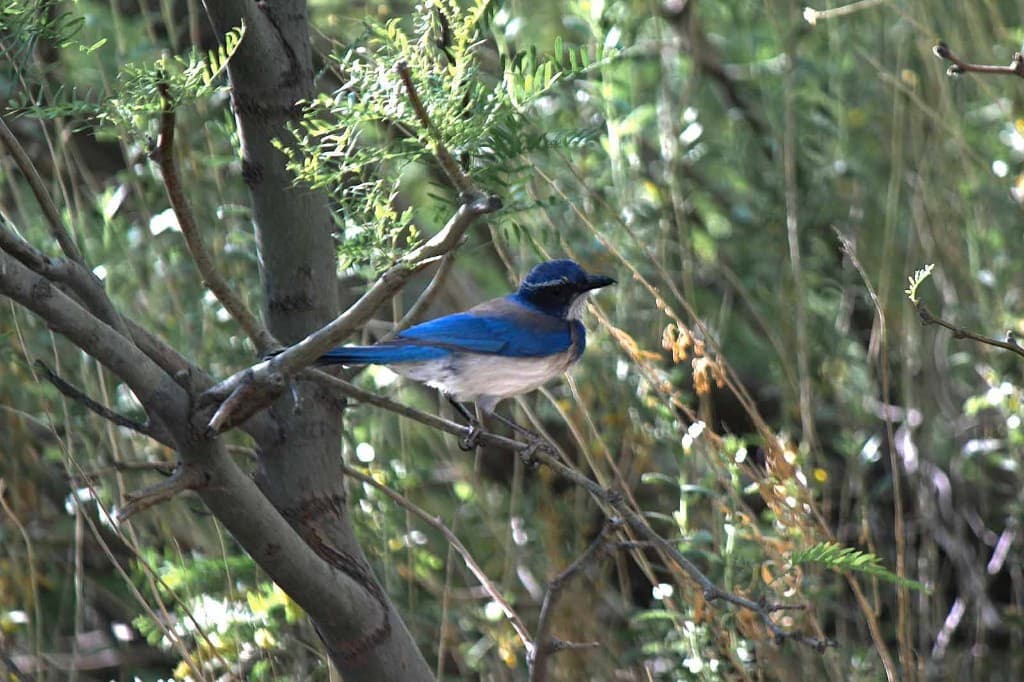
California scrub-jays are year-round in planted neighborhoods, oaks, and the wetter west side of the basin — Morongo Valley, Big Morongo, and Yucca Valley yards with trees. They are the coastal and oak-woodland jay. The 2016 split retired the old name “western scrub-jay”: the brighter bird with a hooked bill and a clean white throat is California; the dingier, thinner-billed bird of pinyon–juniper to the east is Woodhouse’s scrub-jay (Aphelocoma woodhouseii). A jay on a Joshua Tree lot or a Landers pinyon flat is worth a second look. Do not ID on zip code alone; both species wander.
How to tell it
Adults have a blue head, wings, and tail, a brown-gray back, a white belly, and a white throat cut by a blue necklace. The eyebrow is pale and the bill is fairly stout with a slight hook, built for acorns. Woodhouse’s is paler blue-gray overall, with a less contrasting throat and a slimmer, straighter bill for pinyon seeds. The call is a harsh, rising “shreeenk,” often from a rooftop or a fence. They are smaller than a raven, larger than a sparrow, and they hop with the tail slightly cocked. Juveniles are duller and can look almost gray-headed for a few weeks.
What they are doing in the yard
They cache acorns, peanuts, and other seeds in soil, under shingles, and in flowerpots, then come back later. Cornell’s account is the backup for that habit and for the nest-raiding: they take eggs and nestlings of smaller birds, which is ordinary jay work, not a neighborhood crisis. They also eat insects, fruit, and the occasional lizard. A tray of peanuts will pull a pair onto the patio and keep them there. That also pulls ravens and, eventually, a coyote that learned the same porch.
Neighbors, not pets
They are protected under the Migratory Bird Treaty Act. Shooting one for stealing eggs, or taking a fledgling that is being fed on the ground, is a federal problem. Fledglings sit low for a day or two; the adults are usually nearby. Outdoor cats take them. Windows that face a feeder or a wash tree will collect a jay once. They are loud on purpose. If the noise is the complaint, skip the feeder.